


AC Evaluation and Repair in Albuquerque: What Actually Happens When You Bring It In
May 15, 2026
Beat Summer Battery Death: Up to $25 Back on a Qualifying Battery at L&S
July 1, 2026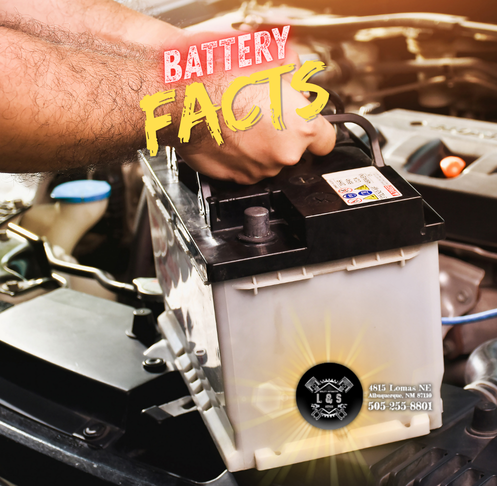
Most drivers think of winter as the season that kills car batteries. The image is familiar. A cold morning, a slow crank, a dashboard full of warning lights. The truth is different, and especially different here. In Albuquerque, summer heat does more damage to your battery than winter cold ever will. Winter just exposes the damage that summer already did. With high desert heat building through June, this is the right month to understand what is happening inside the battery under your hood.
– Heat accelerates the chemistry that destroys a battery from the inside. Industry data shows lead acid battery life is roughly cut in half for every 15 degrees Fahrenheit above 77 degrees of sustained operating temperature.
– A battery that cranks fine today can still be near the end of its life. The only reliable way to know how much capacity you have left is a proper load test, not how it sounds when you turn the key.
– AGM batteries are built differently and tolerate Albuquerque conditions better than standard flooded batteries, which matters for vehicles with start stop systems and for drivers who want longer service life.
The Chemistry Heat Quietly Destroys
A conventional automotive battery is a chemical system. Lead plates sit in a sulfuric acid and water electrolyte, and discharging and charging the battery moves ions back and forth between those plates. The reactions are temperature sensitive in a way most drivers never see. Higher temperatures speed up the chemistry across the board, which is why a battery starts a hot engine easily, but the same speed also accelerates the reactions that wear it out.
Two things happen inside a hot battery that you cannot see. First, water in the electrolyte evaporates faster, which raises the acid concentration and stresses the plates. Second, the positive grids inside the battery slowly corrode, and that corrosion accelerates sharply with heat. The Battery Council International, the industry standards body, has long cited the rule of thumb that lead acid battery life is approximately halved for every 15 degree rise above 77 degrees Fahrenheit. Under the hood of a car parked on Lomas Boulevard in July, the battery routinely sits well above 100 degrees. The clock runs fast.
Why Albuquerque Is Especially Hard on Batteries
Our climate stacks two factors that compound the heat problem. The first is the heat itself, sustained over months. Engine bay temperatures here regularly exceed 140 to 160 degrees during summer afternoons, and they do not get the overnight relief that more humid climates give. The second is elevation. At roughly 5,000 feet, atmospheric pressure is lower, which means less air mass moves through the engine bay to cool components, and electronic loads on modern vehicles run a little harder. Neither factor alone is catastrophic, but together they shorten battery life noticeably compared with a vehicle that lives at sea level in a mild climate.
The practical result is that the average battery life in Albuquerque tends to run closer to three or four years rather than the five to six you sometimes hear quoted in industry averages. That is not a defect. It is the cost of the conditions. The key is to know where you are in that lifespan before the battery fails, not after.
How a Proper Battery Test Actually Works
You cannot tell a battery’s true condition from how it sounds when you start the car. A battery near the end of its life will crank perfectly well right up until the morning it does not. The way to measure capacity honestly is a load test, and it is one of the most useful five minutes of service you can ask for.
A load test applies a calibrated electrical load to the battery, typically about half of its Cold Cranking Amps rating for about 15 seconds, while measuring how the voltage holds up under that load. CCA is the industry standard for measuring how much current a battery can deliver at zero degrees Fahrenheit. Even though the name references cold, the rating is also the cleanest way to measure usable capacity at any temperature. A healthy battery holds its voltage well above a defined threshold under load. A weak battery sags quickly, which tells you the internal plates have lost capacity even if the resting voltage looked fine on a multimeter.
This is the test that separates a battery with two good summers left from one that will leave you stranded in August. We do battery testing at L&S as part of routine service, and we can tell you with confidence where you stand.
The AGM Question
You may have seen the term AGM on battery shelves and wondered whether it is worth the higher price. AGM stands for Absorbent Glass Mat, and it describes a battery construction where the electrolyte is held in a fiberglass mat between the plates rather than sloshing around as liquid. The differences matter in our conditions.
AGM batteries are sealed, so they do not lose water through evaporation the way conventional flooded batteries do. They tolerate vibration better, which extends life in vehicles that see rough roads. They generally handle deep discharge cycles more gracefully, which matters for vehicles with start stop systems, large electrical loads, or extended idling. In a high desert climate that punishes flooded batteries through evaporation and heat cycling, AGM construction gives a meaningful service life advantage for many drivers. It is not the right choice for every vehicle or every budget, but it is worth a conversation. The NAPA Legend Premium AGM is one of the AGM options we install regularly.
Warning Signs Your Battery Is on the Way Out
Batteries do give warning, but the signs are subtle and easy to dismiss until they are not.
– A slower than usual crank, even by a fraction of a second
– Dim headlights at idle, or headlights that visibly brighten when you rev the engine
– Electrical accessories that act erratic when the engine is off, like a radio that resets or windows that move slowly
– A check engine or battery light that appears intermittently
– Corrosion or white powdery buildup on the battery terminals
– A battery that is more than three years old and has not been tested
A free or low cost battery test resolves all of these. The cost of being wrong about your battery is a tow and a service call at the worst possible moment. The cost of being right is peace of mind for the summer.
What Replacement Actually Looks Like
If a test shows your battery is at the end of its service life, replacement is one of the more straightforward jobs in automotive service. The important details are making sure the replacement is the correct group size and CCA rating for your vehicle, that the connections are properly cleaned and torqued, and that the battery is registered with the vehicle’s electrical system on cars that require it. Many newer vehicles need the new battery coded to the charging system so the alternator manages charging correctly. Skipping that step is one of the most common reasons a freshly installed battery underperforms.

The bottom line is that the heat that makes your commute uncomfortable is silently working on the battery under your hood every single day, and the time to find out where you stand is well before the morning it does not start. Stop by L&S Quality Auto Repair for a battery test. We will give you a clear answer on the condition of your battery and your charging system, and every replacement we install is backed by the NAPA AutoCare nationwide warranty.
L&S Quality Auto Repair
4815 Lomas Boulevard NE
Albuquerque, NM 87110
505-255-8801
Monday through Friday, 8:00 AM to 5:30 PM