


Brakes and Batteries: The Two Systems Albuquerque Heat Wears Out Fastest
August 12, 2026
Back to School in 90 Degree Heat: Getting Your Car Ready for the Albuquerque School Run
August 18, 2026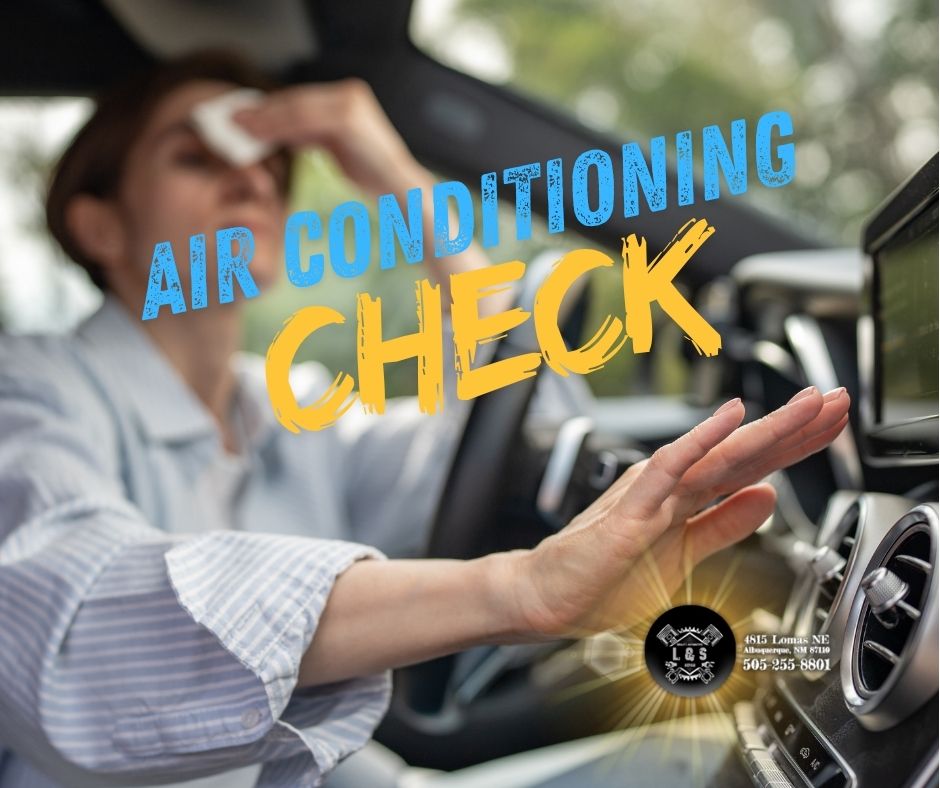
Albuquerque air conditioning does not usually quit in June. It quits in August, after ten straight weeks of upper 90 degree afternoons have worked on a system that was already run ragged. Daily highs in Albuquerque have averaged around 98 degrees this August and September still looks to stay warm, so your compressor has another four weeks of rigorous duty ahead of it. If the air coming out of your vents has gone from cold to merely cool, that is the system telling you something.
- Air conditioning fails late in the season because heat and run time compound, not because of one sudden breakdown
- Weak airflow, warm air at idle, and a musty smell each point to a different repair
- A proper AC service tests pressures and finds the leak rather than simply topping off refrigerant
What August heat actually does to your AC
An automotive AC system is a sealed loop. Refrigerant carries heat out of the cabin, the compressor pressurizes it, and the condenser at the front of your vehicle sheds that heat into the passing air. In August that condenser is trying to dump heat into 90 degree air while sitting behind a grille full of road dust and monsoon grit. The system compensates by running longer and at higher pressure, which stresses the compressor clutch, the seals, and the hoses. Small leaks that were tolerable in April become performance problems by August, because the system no longer has enough refrigerant margin to work with.
Refrigerant loss is the most common cause of weak cooling, and it is almost never a mystery. Refrigerant does not get consumed. If the charge is low, it left through a seal, a hose fitting, an O ring, or a corroded condenser. Adding refrigerant without finding the leak buys a few weeks and puts the same amount back into the atmosphere a second time.
Reading the symptoms before you call
Different symptoms point to genuinely different repairs, and knowing which one you have helps you understand the estimate.
- Air is cold at highway speed but warm at a stoplight: often a condenser airflow or cooling fan problem
- Airflow is weak at every fan setting: usually a clogged cabin air filter or a blend door actuator
- Air is cold for ten minutes and then turns warm: frequently a low charge causing the system to cycle off
- A musty or sour smell on startup: microbial growth on the evaporator, not a refrigerant issue
- A rattle or squeal when the AC engages: compressor clutch or belt
The cabin air filter deserves special mention. Between spring pollen, desert dust, and the windy season blowing everything around, a filter that was clean in March can be visibly loaded by August. It is one of the least expensive parts on your vehicle and one of the most common reasons people believe their AC is failing.
What a real AC service includes
A diagnostic AC service is not a can of refrigerant. Our technicians connect a manifold gauge set to read both high and low side pressures, compare them against the manufacturer’s specification for the ambient temperature that day, and measure the actual temperature at the center vent. If pressures indicate a low charge, we introduce a UV dye or use an electronic sniffer to locate the leak before we recharge anything. We evacuate the system, pull a vacuum to remove moisture, and recharge to the exact weight the manufacturer specifies, because an overcharged system cools worse than a correctly charged one.
That process takes longer than a top off, and it is the difference between a repair that lasts and one that brings you back in September. It also protects the compressor, which is by a wide margin the most expensive component in the system. Compressors fail when they run low on refrigerant, because the refrigerant carries the oil that lubricates them. Chasing a slow leak in August is far cheaper than replacing a compressor, condenser, and drier in October.
How often the system should be checked
Most drivers should have the AC performance checked once a year, ideally in spring before the first heat wave. If you missed that window this year, August is not too late, and it is a better time than most because the system is under real load and problems are easier to reproduce on a gauge. Vehicles older than eight years, vehicles that sit outside all summer, and anything that has already needed a recharge once should be checked annually without exception.
If your air conditioning is not performing the way it did in June, bring it in before the last stretch of hot weather makes the decision for you. Call L&S Quality Auto Repair to schedule an AC performance check, and ask about the NAPA AutoCare 24 month, 24,000 mile nationwide warranty that backs the work.
L&S Quality Auto Repair
4815 Lomas Blvd. NE
Albuquerque, NM 87110
505-546-7734