


Why a Summer Tune-Up Matters at L&S: Ignition Coils, Misfires, and Up to $25 Back
July 1, 2026
Late Summer AC Service in Albuquerque: Why August Is the Month It Fails
August 15, 2026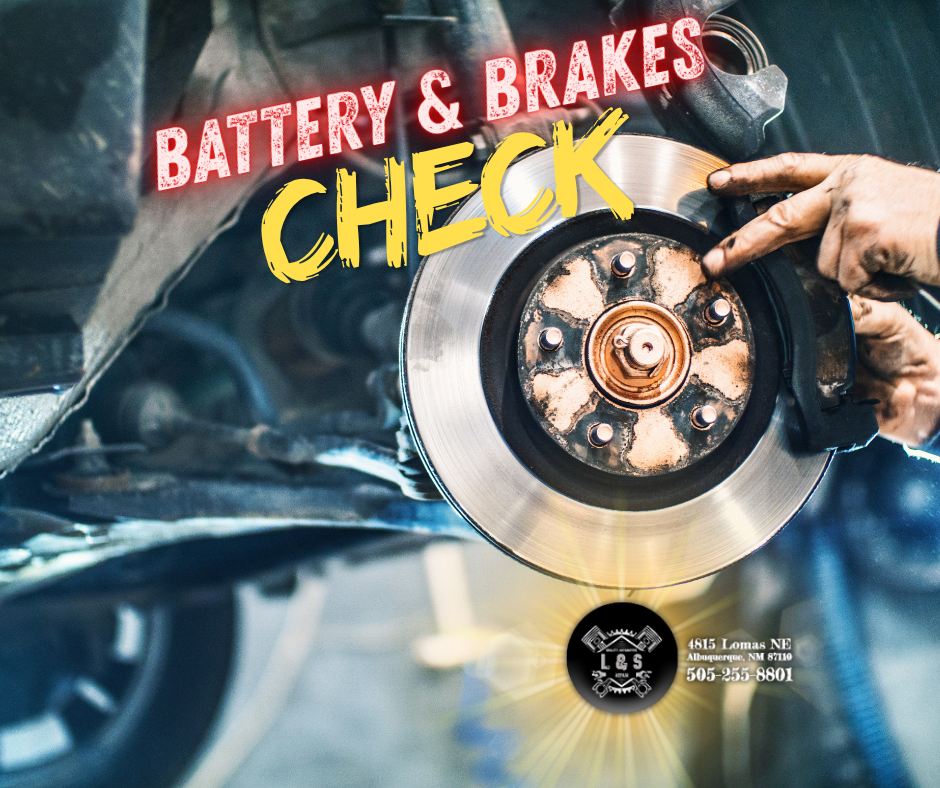
Every climate has its own pattern of failure. In Albuquerque, two systems take the worst of it, and both take it in late summer. Batteries die because heat cooks them from the inside. Brakes fade because heat, elevation changes, and stop and go traffic ask more of them than flat highway driving ever does. Neither system gives you much warning if you are not paying attention, and both are inexpensive to maintain compared to what they cost to replace after a failure.
- Heat, not cold, is the leading cause of battery failure, and August is when a weakened battery finally gives out
- Brake performance depends as much on fluid condition as on pad thickness, and fluid degrades on a schedule
- Both systems can be tested objectively rather than guessed at, and both tests are quick
Why heat kills batteries and cold gets the blame
Cold weather gets the reputation because that is when the battery finally refuses to start the engine. The damage happened months earlier. AAA has stated it plainly: summer heat accelerates the rate of fluid loss and the resulting oxidation of internal battery components, and heat is the number one cause of battery failure and reduced battery life. High temperatures speed up the chemical reactions inside the case, evaporate electrolyte, and corrode the internal grids. By the time a January morning exposes the weakness, the battery has been dying since July.
Underhood temperatures in August run far above the outside air, and a battery mounted near the engine sits in that environment every day. Most batteries are rated for a three to five year service life. In our climate, plan on the shorter end. If yours is past three years, the useful question is not whether it starts this morning but what a load test says about its remaining capacity.
A load test is the whole point. It applies a controlled draw and measures how the battery holds voltage under that load, which reveals a weak cell long before a no start does. The test takes a few minutes. We also check the charging system at the same time, because a failing alternator will destroy a healthy new battery and an overcharging one will boil it.
What Albuquerque driving does to brakes
Brakes convert motion into heat, and everything about local driving increases how much heat they have to manage. Stop and go traffic on Lomas and Central means repeated hard applications with little cooling time between them. The grade changes between the valley and the heights mean sustained braking on descents. Summer air temperatures mean the rotors and calipers start hot and get hotter.
Pad thickness is the measurement most people know about, and it matters. But brake fluid is the part that quietly determines whether the system performs when it is hot. Brake fluid is hygroscopic, meaning it absorbs moisture from the air over time through the reservoir and the flexible lines. Water in the fluid lowers its boiling point. Under hard use, that moisture can flash to vapor, and vapor compresses where fluid does not. The result is a pedal that goes soft or long exactly when you need it most. This is why most manufacturers specify a brake fluid replacement interval measured in years rather than miles, commonly every two to three years, regardless of how much brake material is left.
Warning signs worth acting on
Brake problems announce themselves if you know what to listen for.
- A high pitched squeal at light braking: wear indicators contacting the rotor
- A grinding sound: pads are gone and metal is contacting metal
- Pulsation or steering wheel shake when braking: rotor thickness variation
- The pedal sinking slowly under steady foot pressure: a fluid or master cylinder issue
- The vehicle pulling to one side when braking: a caliper sticking
A grinding noise is not a maintenance item, it is a repair that has already begun to cost more. Pads replaced on time are a routine service. Pads that have destroyed the rotors turn one line item into three.
Checking both at once
The practical answer is to test both systems in the same visit, because both are heat driven and both peak in risk at the same time of year. A battery and charging system test, a brake inspection with measured pad thickness, and a look at fluid condition together take less time than most people expect. You leave with numbers rather than opinions, which lets you decide what to do now and what can reasonably wait until fall.
Heat has been working on your vehicle since May, and August is when it shows. Call L&S Quality Auto Repair to schedule a battery and brake check, and remember that our work is backed by the NAPA AutoCare 24 month, 24,000 mile nationwide warranty, honored at thousands of shops across the country.
L&S Quality Auto Repair
4815 Lomas Blvd. NE
Albuquerque, NM 87110
505-546-7734