


Surprise Wiper Check: Is Your Car Ready for Rain in Albuquerque?
September 16, 2026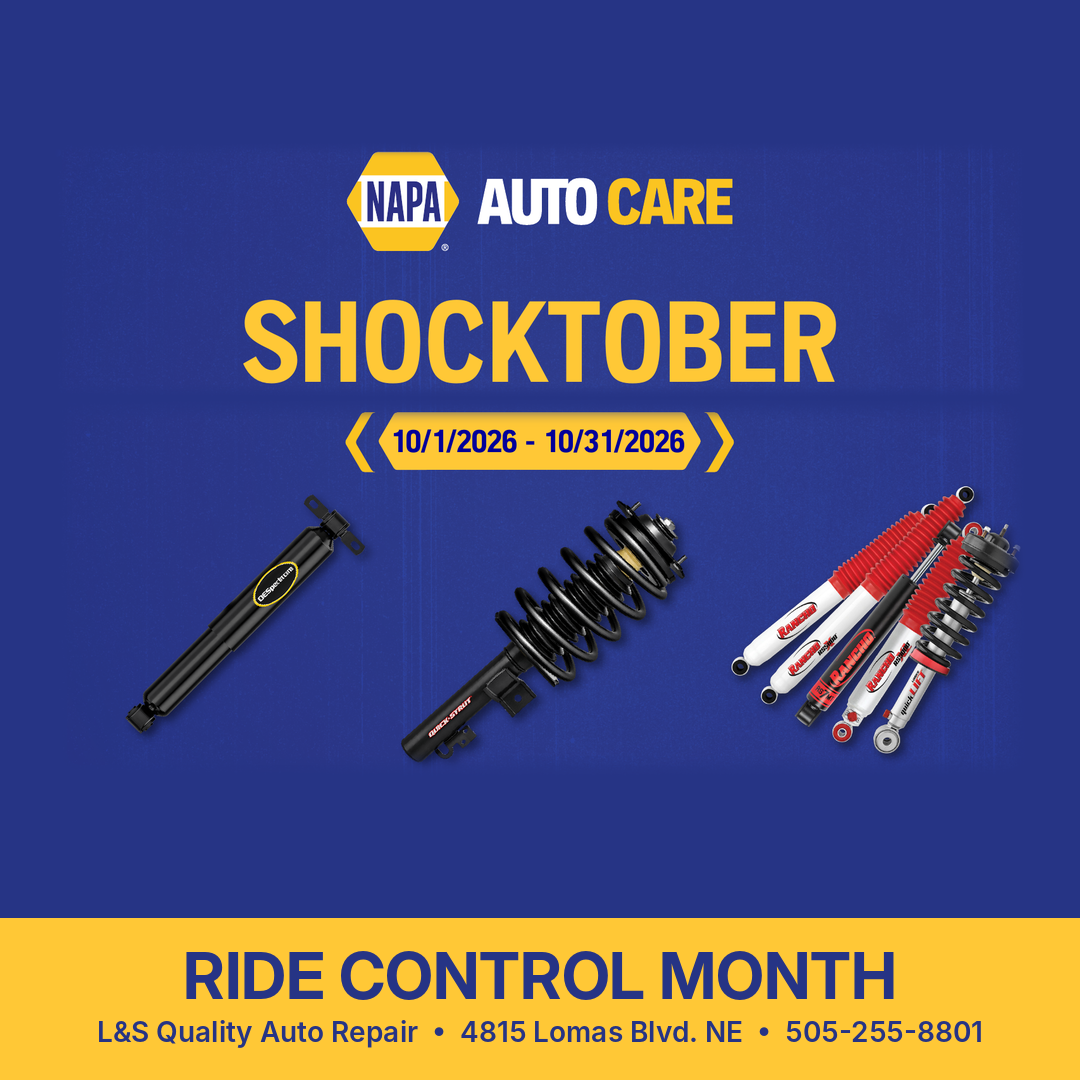
Every October, NAPA AutoCare Centers of New Mexico turn their attention to the parts of your car that nobody thinks about until the ride gets rough. We call it Shocktober. If you have been searching for shocks and struts in Albuquerque, this is the month to have them looked at, because worn ride control has no warning light. The dampers on a 70,000 mile car can be doing a fraction of the work they did when new, and the driver never notices, because the decline took years. Our roads, our grades, and our daily temperature swings all work against suspension parts.
What you will get from this post:
- Why shocks and struts wear out without any symptom you would recognize on a normal commute.
- The four signs of worn ride control our technicians look for, plus one you can check in your own driveway.
- What a Shocktober ride control inspection at L&S covers, and why it takes about 20 minutes.
Springs hold the car up. Dampers control the spring.
The simplest way to understand ride control is this. The springs carry the weight of the vehicle. The shocks and struts control how fast those springs move.
Hit a bump and the spring compresses. Without a damper, it would keep bouncing for several cycles before it settled. A shock absorber stops that by forcing hydraulic fluid through small valves inside a sealed tube, turning the motion into heat. One bump, one controlled rebound, done.
A strut does the same job, but it is also a structural part of the suspension. On most front wheel drive cars and crossovers, the strut carries the spring, locates the wheel, and serves as the pivot for steering. That is why a strut replacement on those vehicles is followed by an alignment.
It is also why NAPA Quick-Strut complete assemblies have become the standard replacement on so many vehicles. They arrive with the spring, upper mount, and bearing already installed, so every wearing part on that corner is new at the same time.
Why worn shocks and struts go unnoticed
The valving inside a damper does not fail all at once. Seals harden, fluid thins, and the piston wears a little at a time over tens of thousands of miles.
The car gets a little floatier each year, and the driver adapts a little each year. That is why the suspension industry recommends a ride control inspection at 50,000 miles and a look at every service after that, rather than waiting for a symptom.
The old trick of pushing down on a fender and watching it settle tells you very little. A damper can lose a large share of its control and still pass that test in a parking lot. It will not pass the first hard stop on a wet road.
Why it matters more than comfort
Anti lock brakes, traction control, and stability control all depend on one thing: the tire staying in contact with the pavement.
A worn damper lets the tire skip over ripples and washboard instead of following them. For that instant, the tire is carrying almost no load. When the tire is in the air, the computer has nothing to work with, and the stopping distance grows.
Worn front struts also let the nose dive under braking. That shifts weight forward and lightens the rear tires at exactly the moment you want all four planted.
Why Albuquerque is hard on shocks and struts
Three things in Albuquerque shorten the life of shocks and struts compared with a flat, mild, well paved city.
Road surface
The patched stretches of Lomas and Central, the expansion joints on the Big I, the steel plates in every construction zone. Each sharp edge is a high frequency hit the damper has to absorb, and the fluid heats up with every one.
Elevation change
Climbing toward the Sandia foothills or coming down La Bajada loads the suspension in long, steady cycles. On a descent, the front dampers work under constant compression while the brakes do their job. A tired front strut makes that long downhill feel loose and vague.
Temperature and sun
A 30 degree swing between a morning in the low 40s and an afternoon near 70 is ordinary here in October. Rubber seals and bushings expand and contract every single day. At 5,000 feet, the UV exposure dries that rubber out faster than it would at sea level.
A seal that has started to weep fluid is the first thing we look for, and in this climate we find it often.
The four signs our technicians check
1. Fluid on the damper body. A film of oil on the outside of a shock or strut means the seal has let go. It only gets worse from there.
2. Tire wear pattern. Cupping, a scalloped pattern of high and low spots around the tread, is the signature of a tire that has been bouncing instead of rolling. Put new tires on without fixing the dampers, and the new set will cup the same way.
3. Mounts and bushings. On steering axles, the upper strut mount carries a bearing. A worn mount clunks over bumps and can bind or pop when you turn the wheel at parking lot speed.
4. Rebound on the lift. With the wheel hanging free, a technician can feel the difference between a damper that resists motion and one that moves like a door hinge.
The one you can check at home
Find an empty street and brake firmly from 30 mph. If the nose drops hard and takes a beat to come back up, or the car rocks after it stops, the front dampers are past their best.
Your mirror will tell you about the rear. If the view behind you shimmers and bounces over rough pavement, the rear dampers are letting the body move more than they should.
You can also run your hand around the tread of a front tire. If it feels scalloped instead of smooth, that is cupping, and it is worth a look.
What a Shocktober ride control inspection covers at L&S
For the rest of October, we are setting aside time for a ride control inspection on any vehicle that comes through the shop. It takes about 20 minutes.
We put the car on the lift and check all four dampers for leaks and damage. We test the mounts and bushings. We read the tire wear, because the tires keep a record of how the suspension has been behaving. Then we show you what we found, with the car in front of you, before anyone talks about a repair.
If the shocks and struts are fine, you leave knowing that. If they are not, you get a written estimate and a clear choice of parts:
- NAPA OESpectrum shocks and struts, built to match the ride your car had when it was new.
- NAPA Quick-Strut complete assemblies, for vehicles where the spring, mount, and bearing should be replaced together.
- Rancho, for trucks and SUVs that spend time on the dirt roads into the Sandias and the Manzanos.
Every ride control repair we do is covered by the NAPA AutoCare 24 month, 24,000 mile nationwide warranty. Parts and labor, honored at NAPA AutoCare Centers nationwide, so the work travels with you whether you are driving to Santa Fe or across the country.
Students and service members, our standing labor discounts apply to ride control work too: 10 percent off labor for college students with a valid ID, and 15 percent off labor for active duty, Guard, Reserve, retirees, and veterans.
Book your Shocktober inspection
Shocks and struts wear quietly, and October is the month we make a point of listening. If your car is past 50,000 miles and nobody has looked at the dampers, text us and we will get you on the lift before Shocktober ends on the 31st.
L&S Quality Auto Repair
4815 Lomas Blvd. NE
Albuquerque, NM 87110
Text: 505-546-7734
Monday through Friday, 8:00 AM to 5:30 PM
NAPA AutoCare Center. 24 month, 24,000 mile nationwide warranty on every repair.